The General of the Sahara in Beştepe
As the sky over the hangars of Diori Hamani Airport was veiled in black smoke on the night of January 29, it was not only aircraft burning — the fifty-year-old security equation of the Sahel was also going up in flames. When IS-Sahel militants crossed the fences of Base Aérienne 101 — considered one of Niamey’s most secure locations — on motorcycles with headlights turned off and set fire to a Turkish-made HÜRKUŞ, a Bayraktar TB2, and several reconnaissance aircraft, only one reality remained in a capital where France had withdrawn, the United States had evacuated its final convoy from Agadez Air Base 201, and Germany had lowered its flag: the Sahel had become a geography destined to determine its own fate, and the hand reaching to shape that destiny was extending from Anatolia.
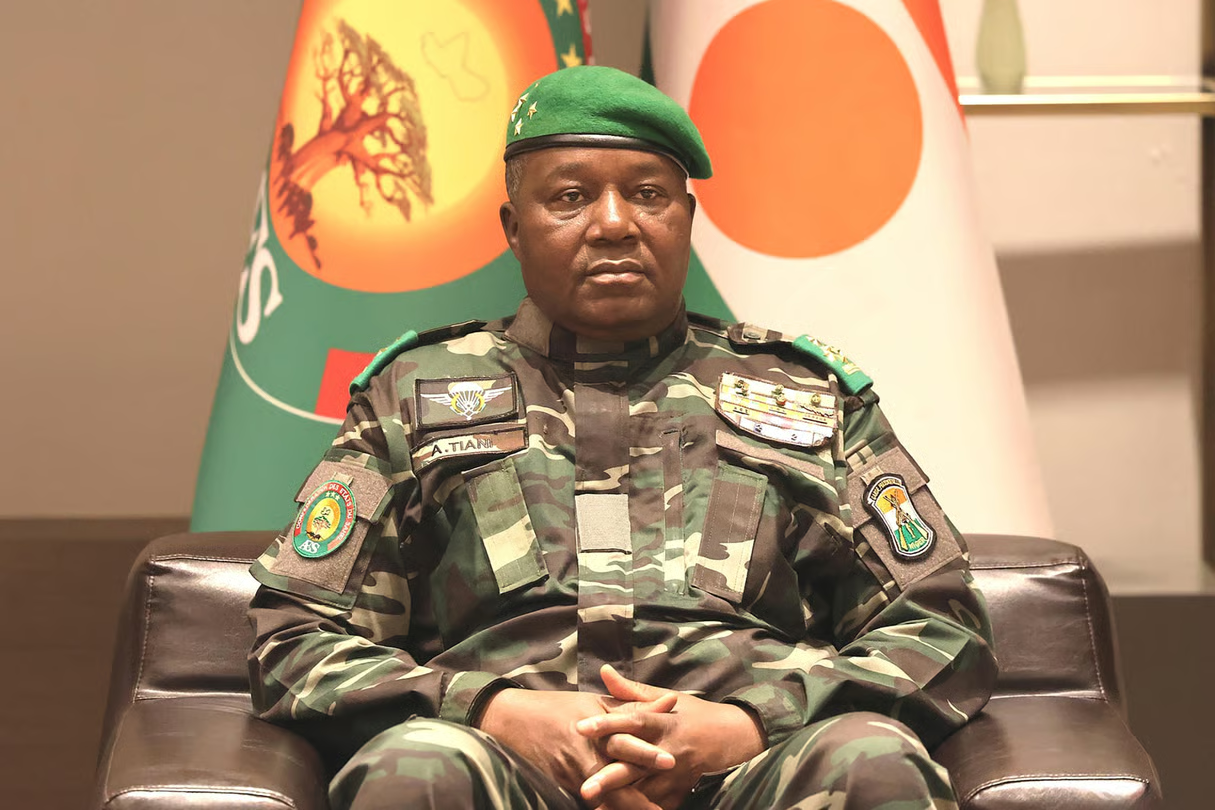
General Abdourahamane Tiani’s arrival at the Presidential Complex on June 4, 2026, is the seal of a decision born from those ashes. It is the arrival of a head of state in a capital — but more profoundly, it is the laying of the foundation stone for a new security architecture that will replace a century-old colonial order.
One Attack, One Doctrine, One Base
The January 29 attack fundamentally transformed the nature of Türkiye–Niger relations overnight. Until then, Ankara had been a “supplier-partner” to Niamey — providing weapons, UAV systems, and military training. After that night, however, Türkiye found itself compelled to assume direct responsibility on Nigerien soil. Because what had been struck was not merely an aircraft — it was the credibility of Turkish deterrence itself.
The response came through the “On-Site Training Support Protocol” signed on April 7, 2026. This protocol signifies that Turkish military specialists will now train Niger’s armed forces directly in the field — on their own soil, against their own enemies, beside their own runways. The decades-long asymmetric warfare experience of the Turkish Armed Forces, intelligence doctrines forged in the fight against terrorism, and military expertise tested in Syria, Libya, and Karabakh are now finding renewed life in the desert winds of the Sahel.
Perhaps the most critical issue on the table in Beştepe on June 4 will be the possibility of establishing a Turkish military base in the Agadez region. The long-anticipated “base clause” of the Military Training Cooperation Agreement signed between Niamey and Ankara in 2021 during the Çavuşoğlu era is now considered ripe for implementation. Agadez is not merely a desert town. It is the center of uranium resources, the northern gateway of the Sahara, the strategic midpoint of the Libya–Algeria–Mali triangle, and the vacuum left behind by the withdrawal of the United States from Niger Air Base 201. The $110 million facility built by Washington now stands empty. Tiani’s visit to Ankara may well answer the question of who will fill that void.
This is not simply a logistical matter — it represents the formal declaration of Türkiye’s strategic depth extending from the southern Mediterranean into the heart of the Sahara. From TURKSOM in Somalia to Al-Watiya in Libya and Tariq bin Ziyad in Qatar — and now potentially Agadez — a strategic resurgence that began with the doctrine of the “Blue Homeland” is evolving into what may be described as a “Desert Homeland.”
Uranium, Oil, and the End of a Colonial Order
When Niger is mentioned, uranium is the first word that comes to mind. For decades, France extracted it at low cost through AREVA (now Orano), drawing immense benefit from the Imouraren mine while much of Niger’s population remained without electricity, despite fueling nearly 70% of France’s electrical grid. The Imouraren reserve — estimated at 200,000 tons — ranks among the largest uranium deposits in the world. In March 2024, the Tiani administration delivered an ultimatum to Orano, seeking to break the chains of this extractive dependency.
Now comes the search for alternatives — and those alternatives are emerging from Ankara through TPAO, MTA, Eti Maden, and private-sector consortiums. The Atlantic Council’s October 2025 report acknowledged that a substantial share of Türkiye’s twenty mining agreements in Africa are concentrated in Ethiopia, Guinea, Niger, and Sudan. Türkiye’s decision to prioritize critical minerals within its 2024–2028 Development Plan demonstrates that this engagement is not a temporary ambition, but the product of a long-term state strategy.
The €152 million agreement for the modernization of Niamey Airport, €38 million for the construction of the new Ministry of Finance building, and €100 million allocated for the Türkiye–Niger Friendship Hospital in Maradi are not acts of charity; they are investments — but investments framed by mutual benefit and strategic sustainability.
The Alliance of Sahel States (AES) and Türkiye: The Invisible Pillar
Founded by Mali, Burkina Faso, and Niger on July 6, 2024, the Alliance of Sahel States (AES) has emerged as West Africa’s new center of gravity, encompassing 71 million people, 2.7 million square kilometers, and a combined GDP of approximately $179 billion. The 6,000-strong AES Joint Force, established in December 2025, has effectively replaced the former G5 Sahel structure.
And upon whose platforms is this new force’s drone fleet built? Türkiye’s.
Mali’s Bayraktar TB2 systems, Burkina Faso’s order of eight TB2s and two AKINCI drones, and Niger’s HÜRKUŞ fleet indicate that while Türkiye may not be an official member of AES, it has become its invisible pillar. Tiani’s visit to Ankara is opening not only the Niamey–Ankara axis but also a formal political dialogue between the AES bloc and Türkiye — stretching across a strategic arc from Algeria to Senegal and from Chad to Mali.
This Is Not Merely About Weapons — It Is About Trust
One point must be made with clarity: Türkiye’s success in Africa cannot be explained solely through Bayraktar drones or ministerial agreements. The deeper reason lies elsewhere — Türkiye has never approached Africa through a colonial lens.
As acknowledged by Wamkele Mene, Secretary-General of the African Continental Free Trade Area (AfCFTA), Türkiye carries no colonial legacy on the continent. For societies that endured decades under French tanks, British-imposed borders, and Belgian extraction systems, this distinction carries immense significance.
TİKA’s office in Niamey, opened in 2014, has contributed to dozens of projects ranging from village wells and maternity hospitals to fistula treatment centers and technical schools. The schools of the Maarif Foundation, mosques built through the Diyanet Foundation, and humanitarian efforts by the Turkish Red Crescent represent more than state projects — they symbolize a civilizational hand extended in solidarity. And the peoples of the Sahel possess enough historical memory to distinguish such a hand from the grip of colonialism.
What Will Be Signed on June 4 Is More Than a Protocol
When President Erdoğan and General Tiani sit across the table in Beştepe, it will not only be the two leaders present in spirit. The ghost of Charles de Gaulle — as the fading breath of colonial ambition. The desert skies once crossed by Antoine de Saint-Exupéry — now witnessing new banners. The shadow of Lumumba — reminding the world that the desire for freedom never dies. And, undoubtedly, the vision of Mustafa Kemal Atatürk — “Peace at home, peace in the world.”
What will be signed is not merely a defense agreement, a mining contract, or an infrastructure loan. What will be signed is the symbolic closure of one era and the opening of another: the end of the colonial age and the beginning of an era in which historically marginalized geographies shape their destinies alongside equal partners.
A Final Note
Under President Erdoğan’s leadership, Türkiye has introduced what many perceive as a new paradigm in Africa. It extended not the hand of a predator, but of a partner; not claws, but solidarity. It arrived not only with military equipment, but also with hospitals.
The smoke rising from the HÜRKUŞ aircraft that burned on the runway of Diori Hamani Airport on the night of January 29 may well take the shape of a flag over Beştepe on the morning of June 4. Beneath that flag, a general will walk from the desert toward Anatolia to build a bridge. The stones of that bridge may be defense cooperation, its mortar friendship, but its foundation — its true foundation — will be built upon dignity and honor.
This is the gateway of the “Century of Türkiye” opening toward the Sahara.
And I am honored to witness the first generation walking through that gate.
— Tuğçe
May 20, 2026